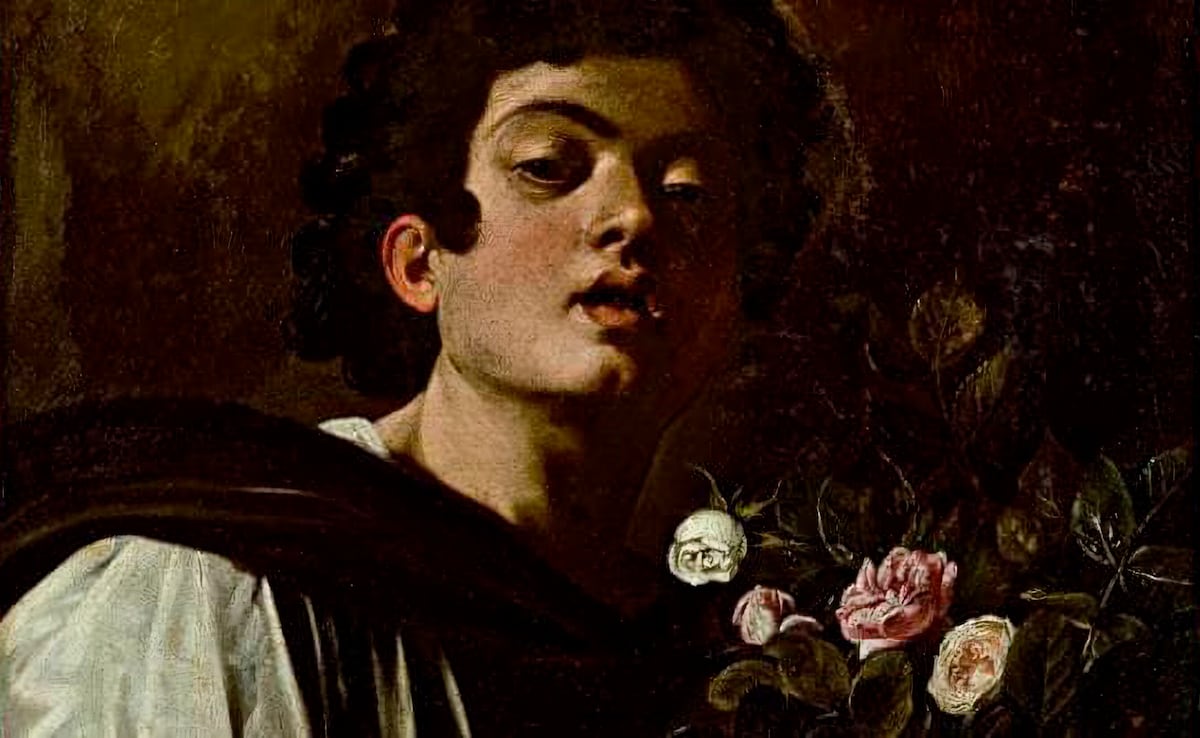
Maria Cristina Terzaghi, one of the leading specialists on Caravaggio, has disclosed that she identified a lost work by the artist in the back room of a Paris gallery three years ago. She made the discovery public in an article for the Italian daily La Repubblica, according to EL PAÍS, which reports that a photograph of the canvas has now been shown for the first time.
The painting, known as Young Man with a Pitcher of Roses (Giovane con caraffa di rose), is dated to 1596–1597. That places it at the very start of the career of Michelangelo Merisi, called Caravaggio, when he was about 25 and had recently arrived in Rome from Milan.
Terzaghi described coming across the work on a grey winter day in the storeroom of a Paris gallery. She had previously identified another Caravaggio, Ecce Homo, when it surfaced in Madrid in 2021.
Why it matters
The existence and subject of the painting were already known because four copies survive, but the original had never been located. According to Terzaghi, the canvas now brought to light is of very high quality and surpasses the reproductions. EL PAÍS describes it as one of the prized pieces in the long-running hunt for Caravaggio's missing works, a search that has produced several surprises in recent years.
The announcement also lands amid fresh attribution news. The same weekend, at a conference in Montepulciano in Tuscany, another prominent Caravaggio scholar, Gianni Papi, said a portrait of a young man auctioned years ago — then catalogued as by a 16th-century Tuscan school painter — is also by Caravaggio. Details of that claim are to be published shortly, EL PAÍS reports.
Rumours of the Paris find had circulated for some time, with talk of the discovery dating back to at least 2025. The La Repubblica article makes it official.
A documented journey from Rome to Paris
The painting's history is unusually well recorded. On 1 August 1607 it appeared in an inventory of belongings of the artist and entrepreneur Giuseppe Cesari d'Arpino, who was forced to hand over his entire art collection to the Papal State to secure his release after being arrested over a fight.
The works passed to Pope Paul V, who gave them to his nephew, Cardinal Scipione Borghese. That collection became the foundation of the Galleria Borghese in Rome, which today holds six Caravaggios. The canvas of the young man with roses appears in the gallery's records as early as 1693 and is documented among its holdings until at least 1831.
It was sold after that and reached Paris in the early 20th century. A bookseller owned it, and his widow put it up for auction in 1909, where it was listed as the work of an anonymous Italian painter. The buyer was an ancestor of the current owner, who, according to EL PAÍS, had no idea what he possessed.
A mirror in the water
One striking feature of the composition is a reflected second figure, possibly a self-portrait by Caravaggio. It appears in the water inside the pitcher, where a window and another person can be seen — a detail that matches, almost exactly, a written description of the painting by Giovanni Baglione, a rival of the artist at the time. Baglione wrote of a pitcher of flowers rendered with the transparency of water and glass, the reflections of a room's window, and blossoms sprinkled with the freshest dew.
Terzaghi says the work is closely tied, in concept and form, to another early Caravaggio, Boy Bitten by a Lizard. In her view, after the success of that earlier picture the artist repeated the formula, possibly intending a series devoted to the five senses. The first would have concerned touch; the young man with the roses would represent smell.
What happens next
The painting's future, and when the public might see it, remain unsettled. The French state is likely to begin by declaring it a national treasure to block its export and to show interest in buying it. One possible home would be the Louvre, which already holds three Caravaggio canvases.
Based on recent sales of the artist's work, the price could be at least €30 million, EL PAÍS reports — the figure cited for the Ecce Homo found in Spain and the sum Italy paid last March for another recent discovery, the Portrait of Maffeo Barberini.
Fewer than 70 works by Caravaggio are known, though how many have been lost is impossible to establish. In his book Museum of Lost Art, Noah Charney estimates the number at between eight and 115 — a measure of both the scale of the mystery surrounding the artist and the difficulty of the search for his paintings.
Watch for a French export ban and any move by the Louvre, which would settle where the canvas ends up.